

International Data Corporation (IDC) Blog
Sponsored by Meta
Guest IDC Blogger: Roger Beharry Lall
Research Director, Marketing Applications for Growth Companies • Research
Organizations are building agentic AI into customer service workflows. But, interestingly, 54% of those organizations rank improving customer outcomes ahead of simple financial metrics. 1 Teams are measuring success in the agentic era by whether the interaction helped the customer, not by how quickly the ticket closed. They know that a contextualized interaction builds loyalty in ways that cheaper or faster service alone cannot, and that shift represents a new chapter in brands’ efforts to move customer service from a cost center to a revenue driver.
Speed without context erodes trust
Agentic AI opens the opportunity for customer service to drive long-term value through contextualized interactions. But what exactly is context? IDC describes context as verified facts, behavioral signals, real-time intent, and decision history working together. 2 That combination is the difference between an AI customer service agent that merely recognizes a customer and one that knows how to act on the recognition. A contract renewal date is a fact. A shift in support-ticket frequency is a behavioral signal. A frustrated tone in a chat transcript is intent. A prior retention offer on file is decision history. Miss one, and the AI customer service agent knows the customer accurately but understands them poorly.
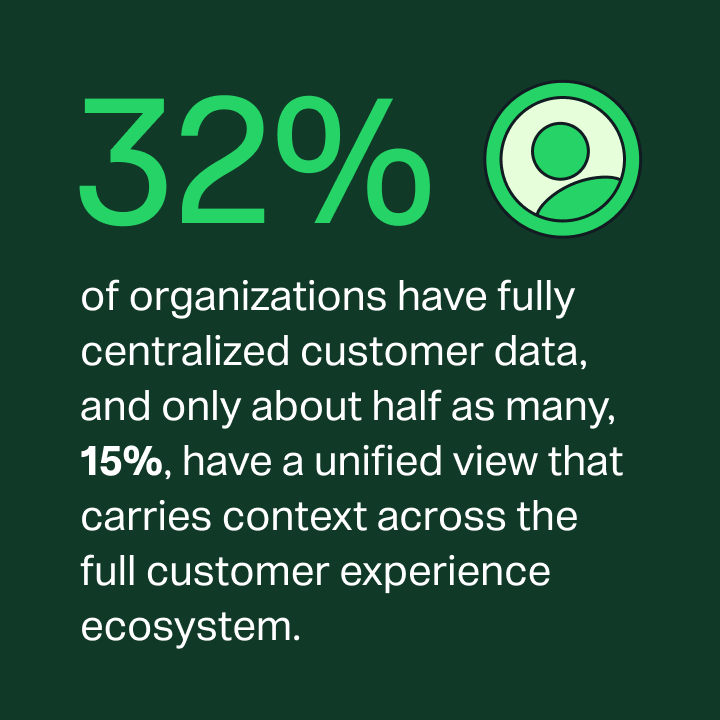
Most organizations aren’t close to this yet. Just 32% have fully centralized customer data, and only about half as many, 15%, have a unified view that carries context across the full customer experience ecosystem. 3 Building toward that means directing AI customer service investment beyond fast resolution alone to the loyalty and future business that a contextualized interaction can build.
That trade-off is already visible in what leaders say matters most. The accuracy of autonomous resolutions, not speed, is the single highest-rated driver of satisfaction with agentic AI performance, at 66%. 4 Reaching that accuracy reliably requires investment in context tooling: privacy-first systems that gather, own, consolidate, and even enhance customer information along the journey.
What’s emerging in AI customer service measurement?
Leading organizations are dropping ticket-closure speed as the primary metric altogether. A resolution can take as long as it needs. What gets tracked instead is whether the customer felt understood and whether the interaction built enough trust to survive the next one.
The AI escalation gap: Where customer trust is won or lost
Some 64% of organizations report satisfaction with how their AI customer service agents handle escalation handoffs, but only 49% can fully preserve customer context once a conversation crosses channels. 4
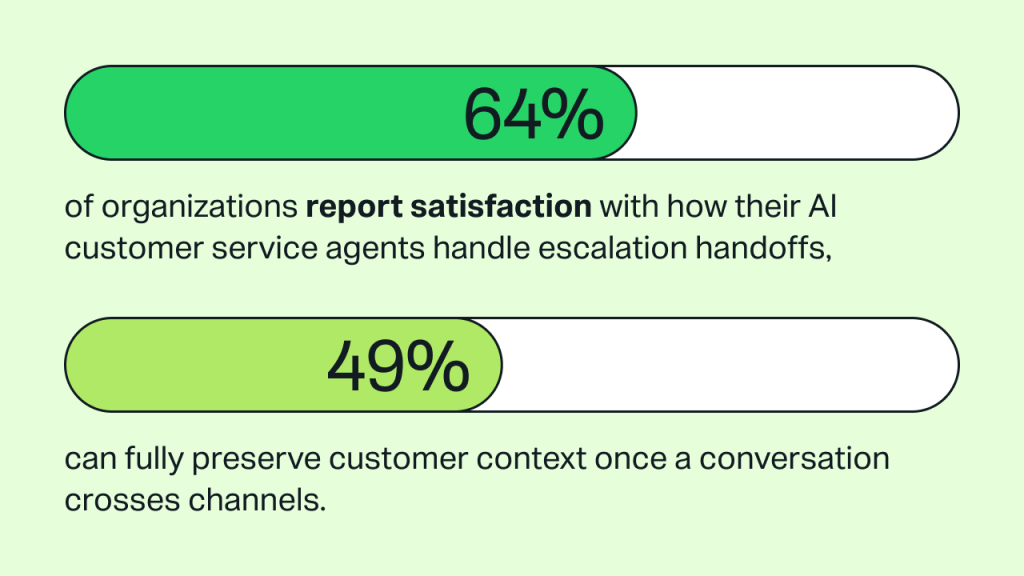
That gap is where agentic customer service actually breaks down. When an AI agent hands off to a human representative, or to another AI agent, the customer experience is binary; either it’s seamless, or it’s a complete conversation restart.
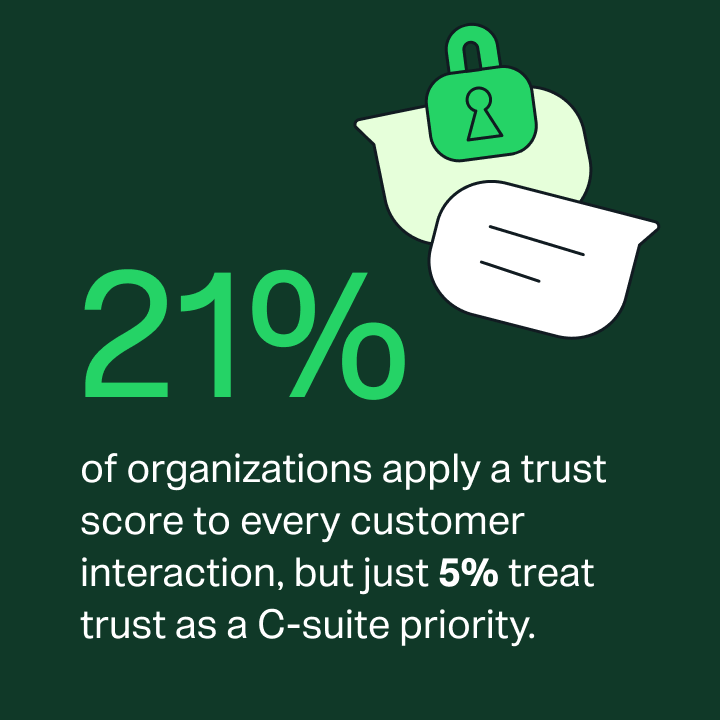
The trust gap shows up at the organizational level, too. Only 21% of organizations apply a trust score to every customer interaction, and only 5% treat trust as a C-suite priority. 3 Organizations are measuring trust faster than leadership is acting on it. Even the organizations that track trust well aren’t necessarily acting on what they find. While technology continues to improve, organizations need not wait for the perfect AI model.
IDC survey data shows 44% are already investing in AI-powered intent detection and routing, and 43% in AI-generated conversation summaries at the point of handoff. 4 Both tactics focus on ensuring data flows to the next actor, whether AI agent or human representative, and are significant steps in the right direction. An escalation that preserves context isn’t just faster. It signals that the brand was listening.
What’s emerging in AI customer service handoff?
The organizations winning at agentic customer service focus on the flow of data and context. AI models matter, but building and maintaining context is often the bigger driver of trust. That’s what makes a brand look coordinated across every engagement.
The upsell window trust opens
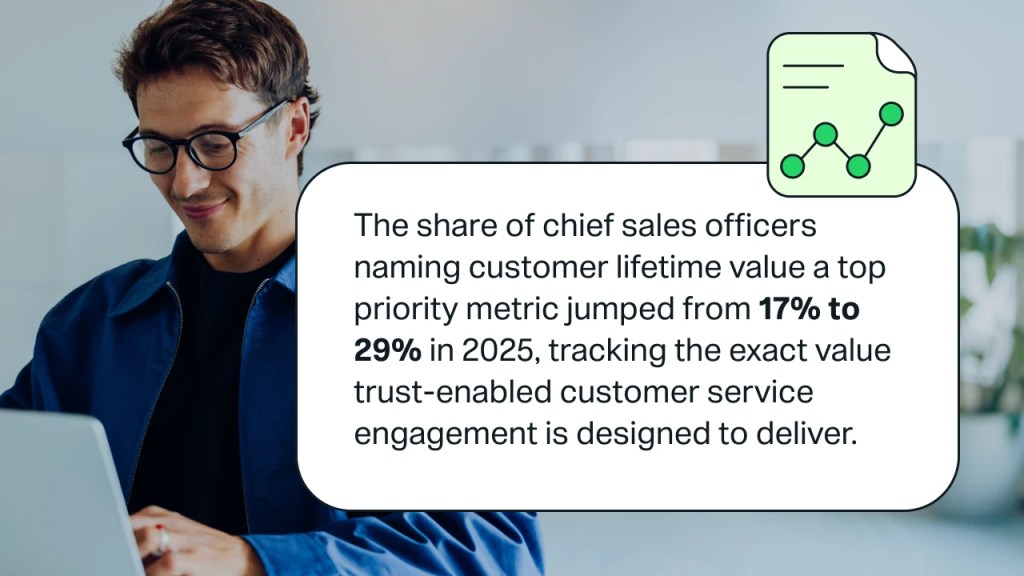
The share of chief sales officers naming customer lifetime value as a top-priority metric jumped from 17% in 2024 to 29% in 2025, tracking the exact value that trust-enabled customer service engagement is designed to deliver. 5 Customer service already generates what sales needs to act on that shift: a signal, a moment, a reason to reach out at the right time.
An AI customer service agent resolves a problem and learns what a customer values, what frustrates them, and the right moment for the next conversation. Today, that knowledge typically disappears. A churn-risk customer gets a discount offer from customer service, but marketing doesn’t know, so the same customer gets a contradictory upsell campaign email that same week. That context stays trapped in a queue and never reaches the next interaction.
The opportunity lies in treating customer service moments as natural, well-timed upsell triggers, earned by the trust built the moment before. A customer whose issue just got resolved and whose sentiment just shifted to positive is in a different life-cycle stage than they were 48 hours before. That timing, paired with the context the AI customer service agent just learned, makes the next conversation feel earned rather than opportunistic.
Trust, not timing alone, is what makes the offer land.
This only works when context moves across functions as fluidly as the customer does. IDC’s agentic mesh research frames the goal: interconnected AI agents that automate handoffs across every customer-facing function, enabling the business to “act as one brand”. 7 Without that, trust built in customer service has nowhere to travel, and revenue teams end up guessing at a relationship they never saw.
What’s emerging in AI customer service leadership?
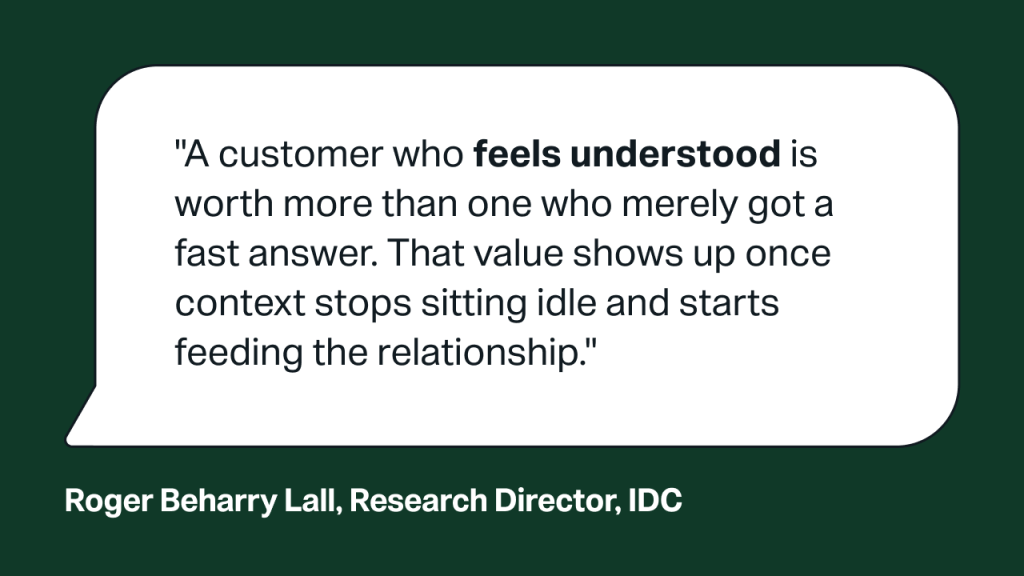
Brands that facilitate context flow across customer service, marketing, and revenue systems will out-execute competitors that still treat every resolved ticket as closed rather than an opening.
Winning agentic customer service
The organizations that win in agentic customer service treat every service moment as a chance to deepen understanding and build a lasting relationship, one earned interaction at a time. That starts with building the data architecture before adding AI customer service agents and separating what’s production ready today (proactive issue detection and context preservation across touchpoints) from what still needs to mature (fully autonomous AI agents handling complex judgment calls without a human representative in the loop).
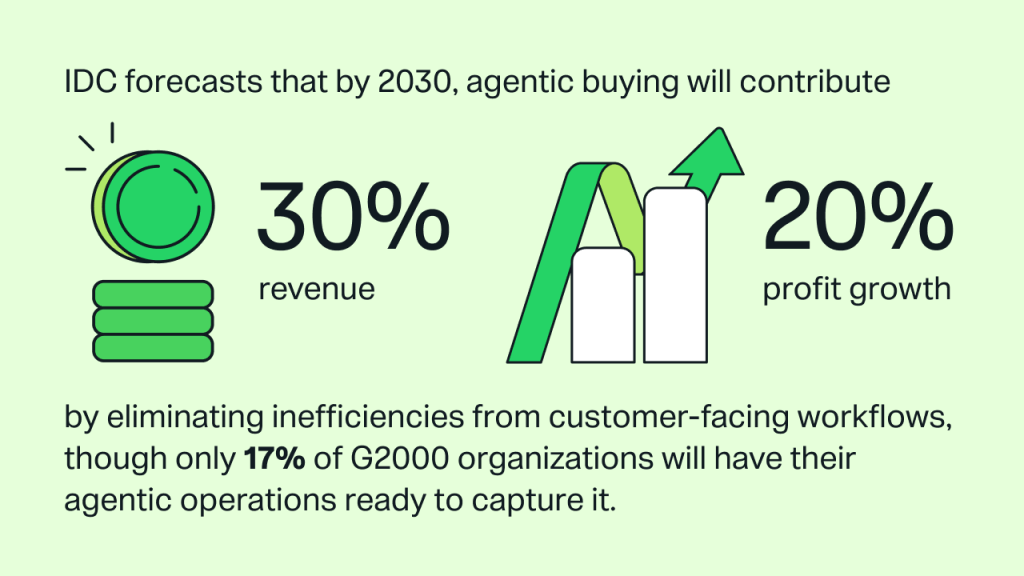
Further out, IDC forecasts that, by 2030, agentic buying will contribute 30% of revenue and 20% of profit growth by eliminating inefficiencies in customer-facing workflows, though only 17% of G2000 organizations will have their agentic operations ready to capture it. 6 Readiness depends on trust: Trust and governance concerns rank among the top 3 barriers organizations cite when deployment stalls. 4 The 17% that get there first are unlikely to be the fastest movers. They’re more likely the ones that solved trust before they scaled.
Winning here means being transparent by default about how customer context gets accessed and used. It also means treating context-sharing across teams as a strategic priority from the start. Cost still matters, but it stops working as a stand-in for speed, customer experience, or revenue growth. The real savings show up when a problem doesn’t have to be solved twice, once in customer service and again in a churn-driven win-back campaign months later. The bigger shift: Cost savings become revenue growth when the same service call turns into a loyalty-driven add-on opportunity rather than just a resolved complaint.
Tickets closed per hour stops being the metric that matters in the AI customer service era. The next time a support conversation escalates, ask whether the customer had to repeat themselves. That single question is the whole audit.
Message from the Sponsor
As businesses build, deploy, and customize AI agents to show up for every customer in every moment, Meta supports organizations across the messaging technologies customers use every day: Messenger, Instagram and WhatsApp. This Meta-commissioned IDC research explores how agentic AI and business messaging are reshaping the future of customer engagement. Discover how enterprise AI messaging solutions help businesses connect with customers and grow through personalized conversations that build trust.
Footnotes:
- Customer-Centric Organizations Are Doubling Down on CX with Agentic AI (IDC #US53318425, April 2025)
- Beyond Customer Data: The Context Foundation AI Agents in CX Are Missing (IDC #US54429926, March 2026)
- Customer Experience Market Overview and Outlook, 2025–2026 (IDC #US53782725, September 2025)
- IDC Survey: State of Contact Center and Customer Service Technology, From Assistance to Autonomy in 2026 (IDC #US54820226, August 2026)
- DC Survey: The Chief Sales Officer Agenda — Challenges, Priorities, and Evolving Role of the CSO (IDC #US54377226, March 2026)
- IDC FutureScape: Worldwide Agentic Experience Orchestration 2026 Predictions (IDC #US53858625, October 2025)
- Agentic Mesh for CX: Automating End-to-End Customer Experience Management (IDC #US53802225, October 2025)