

International Data Corporation (IDC) Blog
Sponsored by Meta
Guest IDC Blogger: Roger Beharry Lall
Research Director, Marketing Applications for Growth Companies • Research
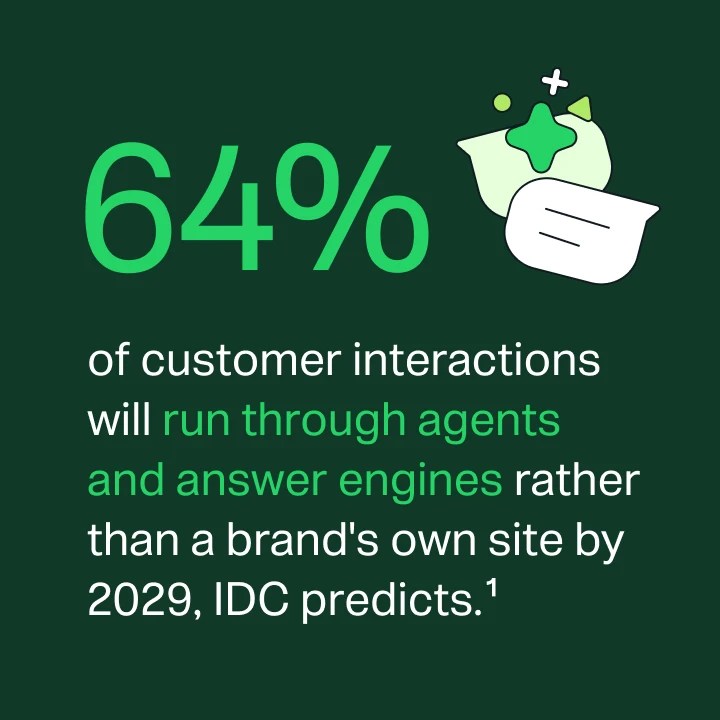
64% of customer interactions will run through agents and answer engines rather than a brand’s own site by 2029, IDC predicts.¹ As agentic commerce takes hold, brands face a defining new challenge: how to balance customer convenience with the business context needed to act on customer interactions. Most channels optimize for one side of that trade-off at the expense of the other. That gap makes deciding where to invest one of the most consequential calls an organization can make right now.
The three major AI customer engagement surfaces
Three commercial surfaces — LLM assistants, brand chatbots, and conversational platforms — are absorbing the bulk of enterprise attention as organizations build out their AI investments. Each carries its own version of the convenience-versus-context trade-off. Together, they represent the top concern for brands navigating this new era of engagement.
1. LLM assistants
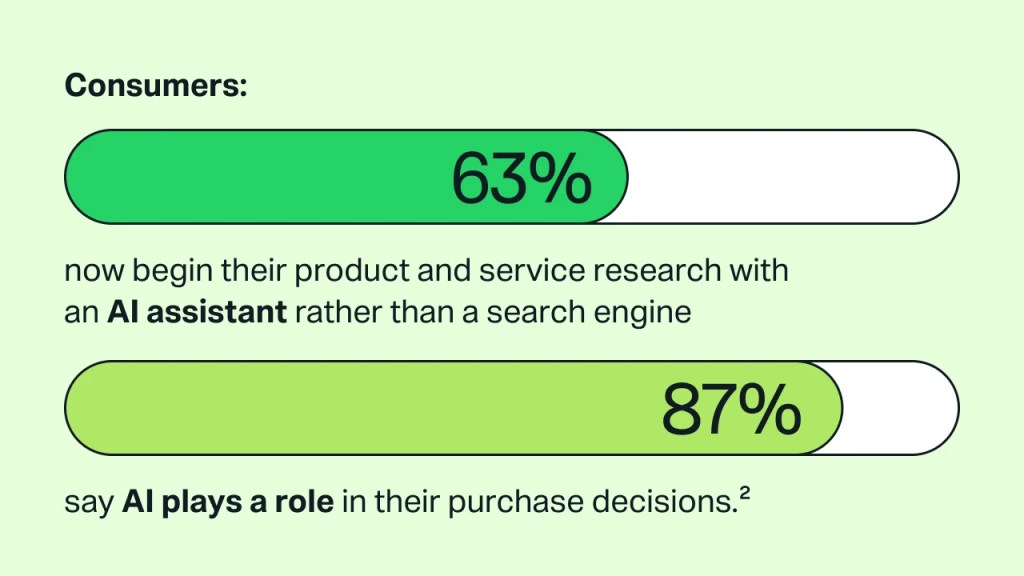
These are common consumer-facing chatbot-style tools that synthesize vast amounts of data and provide great convenience. IDC survey data shows that 63% of consumers now begin their product and service research with an AI assistant rather than a search engine, and 87% say AI plays a role in their purchase decisions.²
What are the risks of LLM discovery to a brand’s agentic commerce strategy?
While using LLM assistants is convenient for the consumer, any data generated stays within the platform, meaning the brand learns nothing about the transaction. There’s no residual data for later reuse, resulting in a siloed transactional experience that can’t connect multiple complex journeys over a lifetime.
2. Brand chatbots
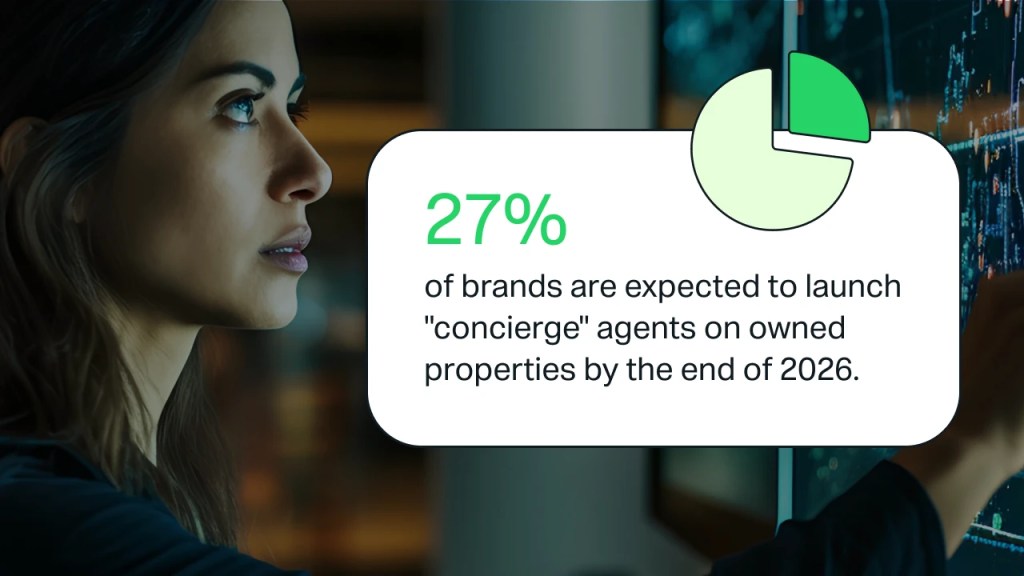
Organizations are increasingly adding proprietary shopping and AI customer service agents to their own websites, an evolution IDC expects this to accelerate, with over a quarter (27%) of brands expected to launch “concierge” agents on owned properties by the end of 2026.¹ These tools sit at the opposite end of the spectrum, offering total visibility and data control.
What are the gaps in a website-focused AI agent strategy?
While excellent for capturing first-party data, brand-owned websites are limited in reach and create consumer friction. By definition, they reach only high-intent buyers who seek them out while ignoring prospects, casual browsers, and undecided buyers. More critically, visiting a brand’s website is a single-purpose activity that fails to fit naturally into daily consumer routines, creating friction in the customer journey.
3. Conversational messaging platforms
An often-overlooked middle ground, they may offer a unique position where convenience and context cease to be opposing forces. Capturing this benefit, however, does require deliberate investment and is mediated by the platform owner’s opt-in and policy terms.
What are the benefits of investment in conversational platforms for AI-enabled consumer engagement?
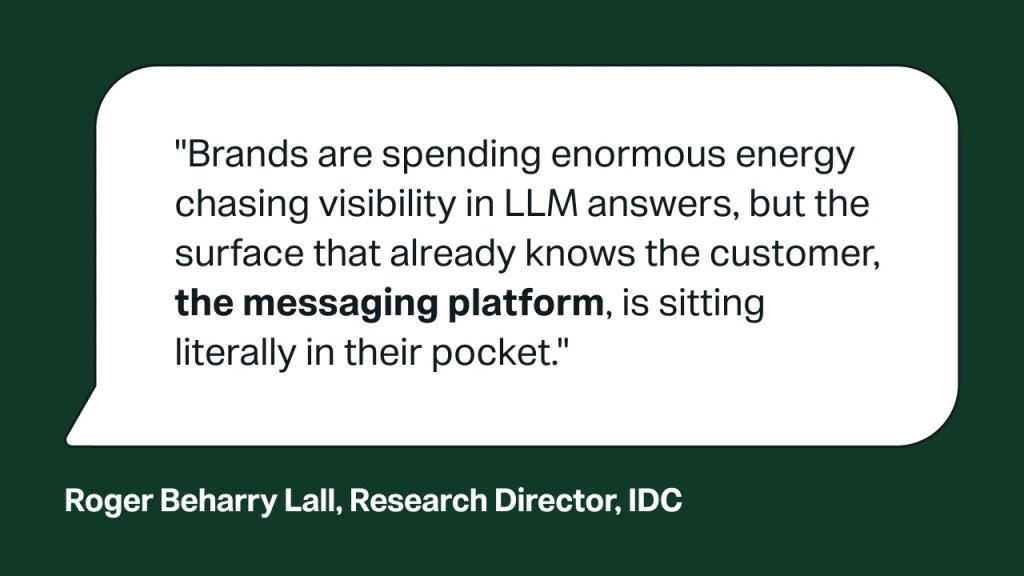
Conversational, or messaging, platforms are deeply integrated into consumers’ daily routines, making them more convenient than traditional websites. Conversational platforms, unlike transactional LLMs, also enable brands to capture valuable first-party data. This ongoing context informs every future interaction, eliminating friction and allowing brands to pick up every conversation exactly where it left off.
Context, the fuel for successful AI engagement strategies
In the coming agentic commerce era, a brand’s edge will come from context, the accumulated history of a customer relationship that lets a brand make each interaction smarter than the last instead of starting from zero. That raises two questions: What exactly is context? And why is it of value?
What is context?
IDC defines context as more than a customer’s purchase history. It’s the fuller real-time picture an AI agent needs to act well — the verified facts of the relationship, the behavioral signals building across channels, the reason the customer is reaching out right now, and a record of what’s already been offered or decided — so that the next interaction builds on the last one instead of repeating it.³ This turns customer data from something disposable into a reusable asset that gets smarter with every exchange, and it’s why investing in the tools that generate it is so critical.
Why is context important for AI engagement throughout the customer journey?
By keeping conversations in a single persistent thread, brands can instantly recognize returning customers and use history to inform every future interaction, both inside and outside the thread, rather than forcing customers to repeat themselves and start from scratch each time.
Conversational messaging platforms: Where convenience and context align

A website’s AI chatbot only sees a customer once they’ve decided to visit and represents friction in the consumer’s day-to-day activities. An AI assistant or LLM sees the query, but not necessarily the customer’s identity or history, and it certainly doesn’t share transactional information. A messaging thread in a conversational platform, however, has the potential to carry both: the history to know what’s worth offering next, and a channel where the customer is already active when the moment is right. That combination lowers cost to serve through faster resolution, provides consumer convenience, and creates the context on which a well-timed upsell or cross-sell depends. For brands building towards an agentic commerce future, messaging is one of the few places in the AI customer engagement landscape where everything comes together.
While much attention of late has been paid to the more visible, still-evolving landscape of AI discovery and LLM optimizations, the channel already built to deliver convenience and context at once remains under-resourced in many organizations’ AI strategies.
The businesses that win the next phase of AI-driven customer engagement won’t get there just by showing up on a particular model or chasing a rented audience. They’ll win by earning customer trust and building intimacy throughout the multichannel journey, and messaging is where that trust compounds fastest. That’s why conversational messaging platforms deserve investment, not just as today’s AI interaction medium, but as the data foundation on which tomorrow’s agentic commerce strategies will depend.
Footnotes
- IDC FutureScape: Worldwide Agentic Experience Orchestration 2026 Predictions (IDC #US53858625, October 2025)
- Consumer AI and the Consumer Customer Journey (IDC #US54596426, June 2026)
- Beyond Customer Data: The Context Foundation AI Agents in CX Are Missing (IDC #US54429926, March 2026)
Message from the Sponsor
As businesses build, deploy, and customize AI agents to show up for every customer in every moment, Meta supports organizations across the messaging technologies customers use every day: Messenger, Instagram and WhatsApp. This Meta-commissioned IDC research explores how agentic AI and business messaging are reshaping the future of customer engagement. Discover how enterprise AI messaging solutions help businesses connect with customers and grow through personalized conversations that build trust.