


Region
Latin America, Asia Pacific, Europe, Middle East, Africa
Industry
Technology
Solution
WhatsApp Business Platform, utility messages, authentication messages, marketing messages
Region
Latin America, Asia Pacific, Europe, Middle East, Africa
Industry
Technology
Solution
WhatsApp Business Platform, utility messages, authentication messages, marketing messages
Region
Latin America, Asia Pacific, Europe, Middle East, Africa
Industry
Technology
Solution
WhatsApp Business Platform, utility messages, authentication messages, marketing messages
The goal
Reliable and secure communications at scale
With operations in more than 70 countries and billions of messages sent annually among riders, drivers and couriers, Uber is committed to continually improving security, reliability and communication.
Their Story
Setting the standard for elevated mobile experiences
In 2010, Uber re-architected direct transportation to reduce the hassle of trying to be in the right place at the right time to find a ride. The company’s vision was to create a more efficient, elegant and customer-centric experience, so riders could easily find a hassle-free and comfortable ride at any time. Communication was central to this elevated experience, in the form of notifications and messages exchanged via Uber’s app. Uber’s success spoke for itself: timely, on-demand rides became the new transportation mode of choice.
At its core, Uber remains a customer-obsessed company that’s committed to creating hassle-free, innovative and reliable experiences for riders and earners. As Uber’s ridership has expanded, so have the opportunities to level up the customer experience. With live ETAs, in-app updates and frictionless payments, Uber’s goal is to continually add value by making the complex feel effortless.
The opportunity
Evolving beyond legacy channels
Uber views itself as more than a ride-hailing app. Rapid technological advances have accelerated consumer expectations for faster, more seamless access to information and services. Uber has embraced this expectation by integrating delivery services into its core experiences—for example, by making it possible for riders to order from Uber Eats during their journey.
To continue raising the bar and expanding access to its unified services, Uber is now innovating how it communicates off-platform in several regions, including Latin America, Asia and Europe, by tapping utility messages for timely notifications, authentication messages to confirm customer accounts, and marketing messages for important rider and earner communications. The Uber team decided to incorporate WhatsApp after identifying several vulnerabilities in SMS, which it used across a range of touchpoints, such as sending real-time trip updates for riders and OTPs (one-time passcodes) to verify rider and earner accounts.
An inside look at Uber’s journey
Hear firsthand about the motivation behind Uber’s journey with WhatsApp, and how a strategic approach to rider and driver engagement drove real results.
Featuring David Cinanni, Vice President, Performance Marketing at Uber

David Cinanni,
Vice President,
Performance Marketing, Uber
David Cinanni,
Vice President,
Performance Marketing, Uber
SMS challenges
SMS messages, which appear to recipients as standard text messages, raised fiscal and delivery concerns for Uber and security concerns for riders and earners. While SMS helped the business grow quickly at its earliest stages, the lack of granular data, limited character counts and other challenges frustrated Uber teams that wanted to maintain active communication with riders and earners.
SMS messages, which appear to recipients as standard text messages, raised fiscal and delivery concerns for Uber and security concerns for riders and earners. While SMS helped the business grow quickly at its earliest stages, the lack of granular data, limited character counts and other challenges frustrated Uber teams that wanted to maintain active communication with riders and earners.
SMS lacked crucial reporting data, such as delivery, read receipts, and conversion tracking to show how messages performed.

Partnership with WhatsApp
Pioneering the shift to more interactive, reliable communications
Sending and receiving important messages and updates via mobile is a core component of the rideshare experience. With this functionality not performing as needed, Uber turned to WhatsApp for Business solutions to create a more secure and engaging experience for riders, drivers, and businesses, with more features and functionality than SMS could offer.
Uber recognized the opportunity to once again pioneer a shift in the rideshare ecosystem by steering away from SMS and leveraging messaging on WhatsApp instead. By adopting WhatsApp for Business solutions, Uber believed it could scale communications across key moments in the rider journey with improved timeliness, security and interactivity.
Adoption of WhatsApp was initially championed by Uber general managers in countries where WhatsApp was already embedded in daily life, such as Brazil, India and Mexico. These leaders recognized that SMS was no longer sufficient and that WhatsApp had the potential to yield better data and delivery results. The journey to full adoption was a highly orchestrated cross-functional effort. Uber established a close collaboration between its communications platform team, its CRM team, and Meta, enabling seamless integration with Uber’s internal tools. Utility messages were implemented first to validate the case for WhatsApp, followed by authentication messages and early-stage experiments with marketing messages. Uber had to establish new governance models and upskill internal teams in order to pave the way for better performance.
The WhatsApp product and engineering teams gave their Uber counterparts early access to alpha and beta solutions, and relied on Uber’s status as a trusted partner to provide actionable feedback on how to improve its features. After months of testing and close and day-to-day alignment with Meta, the Uber team reported better performance from messages on WhatsApp compared to SMS.
“We’re really encouraged by the impact WhatsApp is driving across Uber’s platform—strengthening our communication with millions of customers and drivers around the world and unlocking new marketing opportunities at scale. It’s quickly becoming a core part of how we engage with the people who matter to us most.”
Jill Hazelbaker
President & Chief Corporate Affairs Officer, Uber

“We’re really encouraged by the impact WhatsApp is driving across Uber’s platform—strengthening our communication with millions of customers and drivers around the world and unlocking new marketing opportunities at scale. It’s quickly becoming a core part of how we engage with the people who matter to us most.”
Jill Hazelbaker
Chief Marketing Officer, Uber
The Results
Improved engagement and performance
The engineering teams at WhatsApp and Uber collaborated to launch impactful new use cases for WhatsApp, in the belief that the improved functionality of messages on WhatsApp could help the company overcome the challenges of using SMS.
Rather than relying on one-size-fits-all SMS, Uber leveraged the expanded functionality of marketing, utility, and authentication messages on WhatsApp to build custom use cases that unlocked new revenue streams and evolved the company’s communications with riders and earners.

Verified
Messages on WhatsApp have a clear, verified sender. Riders and earners can trust that they’re hearing directly from Uber.

Engaging
Messages aren’t limited to 160 characters. The ability to use photos and rich media gives Uber the ability to create more engaging customer conversations that motivate riders and earners to participate.

Transparent
Uber gets access to the valuable delivery, read and conversion data it didn’t have with SMS, which helps teams continually optimize and improve customer communications.

Efficient
Using WhatsApp has helped streamline pricing and reduced Uber’s reliance on premium SMS delivery routes.
Uber’s messaging evolution

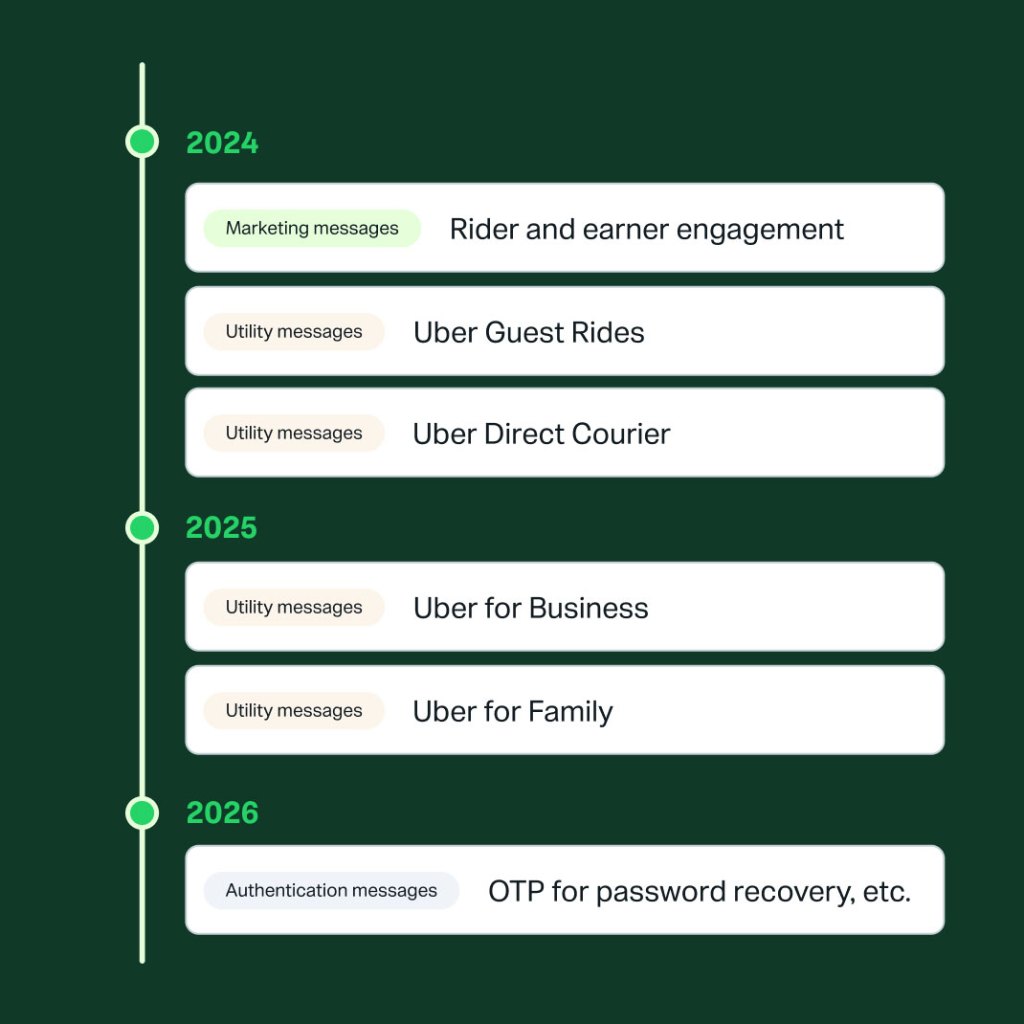
Utility messages
Uber developed more effective, immediate and impactful communications about key Uber features, including: Guest Rides (communicating with guest riders who don’t have the app installed), rider location sharing, Uber for Business ride booking and Uber Direct Courier. Utility messages help ensure that important updates reach customers reliably, improving the overall trip experience.

Authentication messages (OTP)
Uber created a more reliable, secure authentication experience to address important account issues such as verification, password recovery and payment sources by sending OTPs on WhatsApp. This significantly reduced fraud and helped improve customer onboarding success rates.

Marketing messages
Uber has begun opening up new revenue paths by developing cross-sell earning opportunities and re-engagement messaging campaigns for drivers and Uber Eats promotions for riders. This includes targeted campaigns to motivate dormant customers to come back to the app.
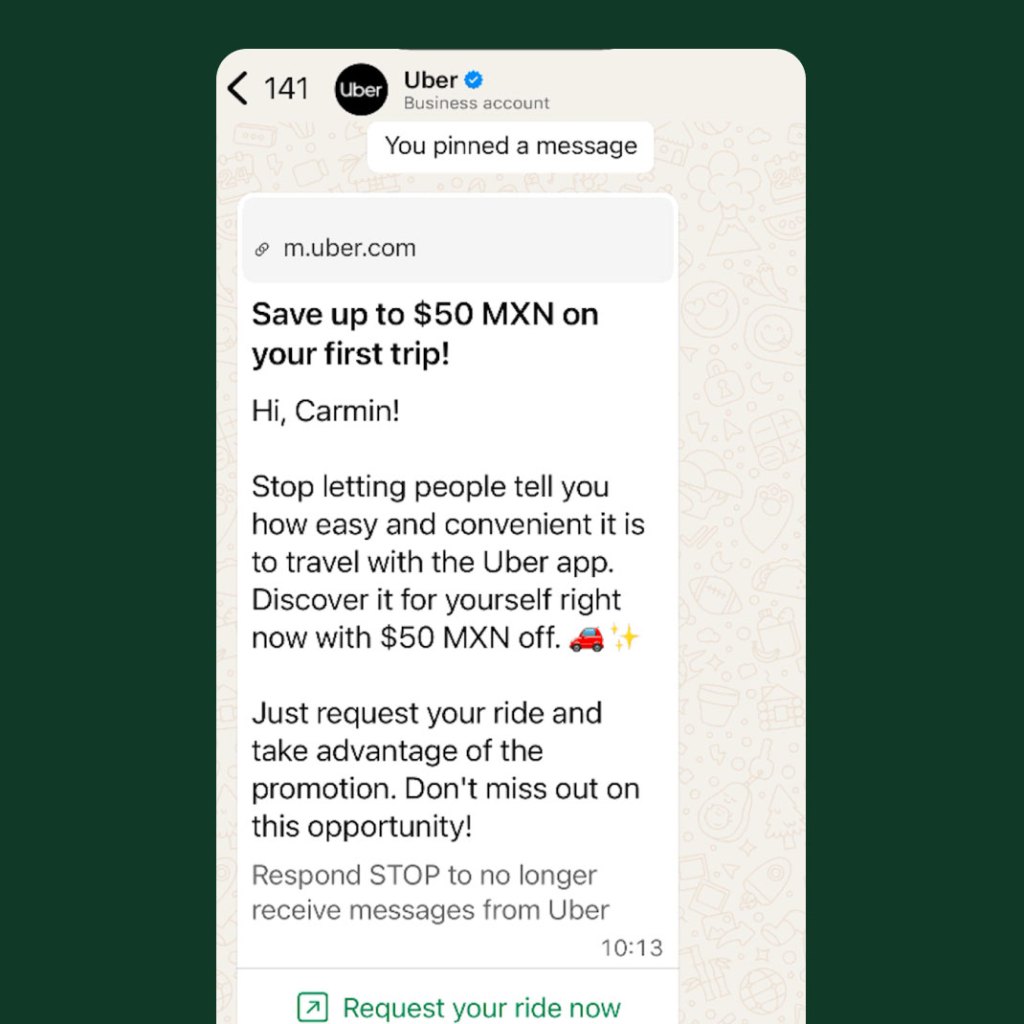
Uber sends marketing messages to re-engage riders in markets around the world.
Close look
Marketing messages: designed for momentum
The Uber team is using marketing messages on WhatsApp to improve the re-engagement experience for both riders and drivers by enabling richer, more behavior-driving communication compared to SMS. In controlled tests overseen by Uber’s data science team that compared identical messages and audiences, WhatsApp consistently outperformed SMS by driving stronger engagement from inactive accounts.
Uber credits the combination of branded messaging, deep links and interactivity in marketing messages on WhatsApp with re-engaging riders by making the experience feel more seamless and relevant than SMS. After adding marketing messages, Uber reported a 3-point lift in re-engagement for high-value riders who’d become inactive within the past year, and a 27% lift among riders who’d been inactive for more than a year, compared to SMS.
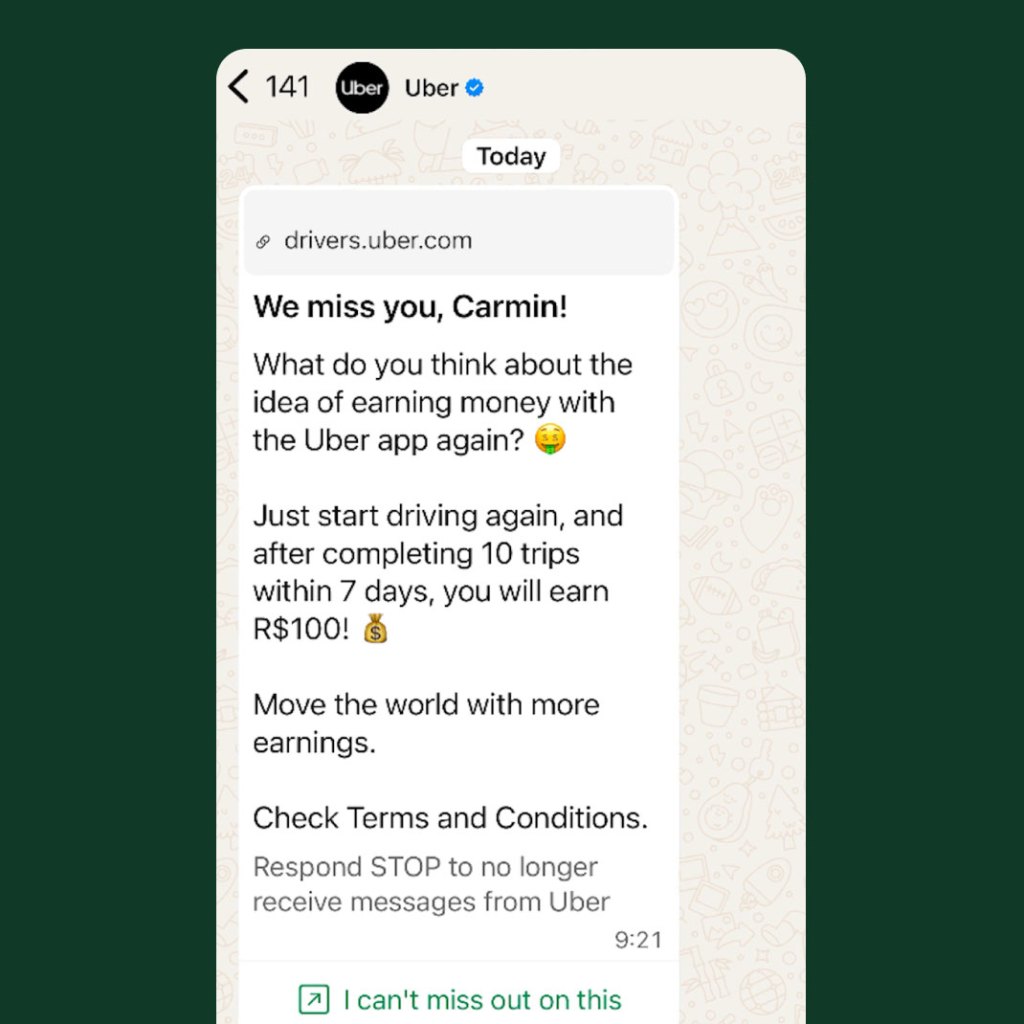
Uber sends marketing messages to highlight earnings opportunities for drivers.
The team used structured, visually rich marketing messages to help build more trust and reduce ambiguity with drivers as well. Uber used marketing messages to highlight earnings opportunities and outline easy-to-follow instructions for how inactive drivers could get back on the road. The team reported a 16% lift in inactive driver resurrection compared to SMS and a 3-point lift in second-trip conversion among earners who’d completed onboarding.
Uber sends marketing messages to highlight earnings opportunities for drivers.

27% lift
In inactive rider resurrection, among riders who’d been inactive for more than a year, attributed to marketing messages on WhatsApp compared to SMS*

16% lift
In inactive driver resurrection, attributed to marketing messages on WhatsApp compared to SMS*
*Results are self-reported and not identifiably repeatable. Generally expected individual results will differ.

David Cinanni,
Vice President,
Performance Marketing, Uber
Looking forward
The messaging journey continues
Together, Uber and Meta are setting the standard for timely, secure and engaging communications. Uber continues to leverage messaging on WhatsApp to build trust, drive growth and deliver exceptional experiences for riders and earners.
- First, Uber plans to scale WhatsApp as a marketing channel, expanding marketing messages beyond riders and earners to its delivery business.
- Second, the team is focused on deeper lifecycle marketing integration, embedding WhatsApp at key friction points—such as onboarding, support and document handling—to improve the end-to-end experience.
- Third, Uber plans to leverage Business AI on WhatsApp to enable more conversational and intuitive interactions aimed at improving its onboarding and support experiences.

What began as a solution to the limitations of SMS is growing to become a full-scale communications strategy built on trust, performance and measurable growth. As Uber grows beyond rides and continues to expand its ecosystem of services, messaging will play an even bigger role in shaping the end-to-end experience. And with plans to integrate conversational AI, Uber continues to raise the bar for how global businesses can connect with customers.
Together, Uber and Meta are building on momentum to help businesses connect with people in ways that are timely, trusted, and consistent—setting a new standard for how global brands show up for customers.
Download the report